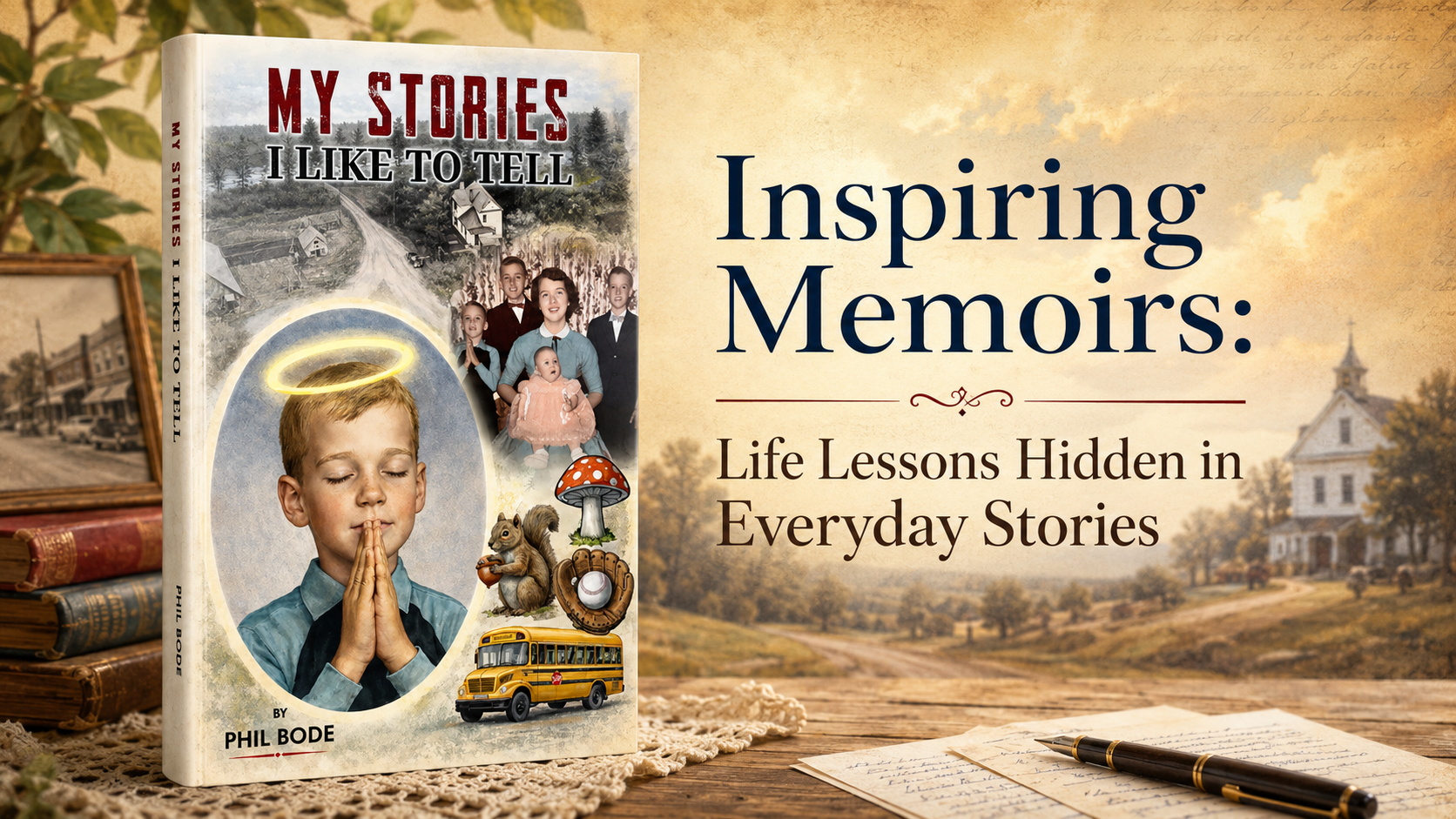
Inspiring memoirs do not always need celebrity fame, impossible survival stories, or world-changing events to leave a lasting mark. Sometimes the most meaningful lessons come from childhood mistakes, family memories, small-town experiences, school-day confusion, farm life, and ordinary moments remembered with honesty.
That is why readers continue to value inspirational memoirs that feel personal and real. They remind us that wisdom is not always delivered through lectures. It often arrives through embarrassment, laughter, discipline, curiosity, and the quiet realization that a small moment taught us something we carried for years.
Phil Bode’s My Stories I Like To Tell fits naturally into this tradition. The book does not try to make everyday life seem larger than it is. Instead, it shows how everyday life already contains enough humor, consequence, and meaning to shape a person’s character. For readers looking for a life lessons book filled with warmth, memory, and reflection, Bode’s storytelling offers a familiar kind of wisdom: the kind learned by living.
Why Readers Connect with Inspirational Memoirs
Readers connect with inspirational memoirs because they recognize themselves in them. A good memoir does not simply tell readers what happened. It makes them remember what it felt like to be young, uncertain, curious, proud, afraid, or caught doing something they should not have done.
The best memoirs often create a feeling of recognition. A child sneaks into a sibling’s room. A gift is saved for a “special occasion” until the moment is gone. A young student misunderstands directions and ends up in the wrong place. These are not distant or unreachable experiences. They are human experiences.
That relatability matters, especially for U.S. readers who often connect deeply with stories of family, school, childhood neighborhoods, rural life, and lessons learned through trial and error. Memoirs grounded in real life create trust because they do not pretend the author was always wise. Instead, they show how wisdom was earned.
In My Stories I Like To Tell, Phil Bode writes from the perspective of someone looking back with humor and humility. His stories are not built around perfection. They are built around mistakes, misunderstandings, consequences, and the kind of realizations that only become clear with time. That honesty is what gives inspirational memoirs their emotional power.
Readers do not only want to be impressed. They want to feel understood. They want stories that allow them to laugh, reflect, and say, “I remember feeling something like that.” When a memoir creates that response, it becomes more than personal history. It becomes shared experience.
Life Lessons Hidden in Everyday Stories
A life lessons book works best when the lessons feel earned, not forced. Readers do not want moral instructions placed on top of a story. They want the story itself to reveal the lesson.
That is one of the strengths of Phil Bode’s storytelling. His memories begin with simple situations: childhood temptation, a prized gift, a school bus ride, a playground mistake, a family misunderstanding. At first, these moments seem small. But as the story unfolds, each one exposes something deeper about responsibility, patience, honesty, courage, self-control, or forgiveness.
In one story, a young boy mistakes bath oil beads for candy and quickly learns that temptation can punish a person without anyone else needing to step in. The humor comes from the panic of the moment, but the wisdom comes from the realization that choices have consequences.
In another, a pair of special blue shorts is saved for “good” until the child outgrows them. The story is funny, tender, and quietly painful because the lesson is so universal. People often wait for the perfect moment to use their gifts, enjoy their blessings, say what matters, or take an opportunity. Then one day, the moment no longer fits.
That is the kind of insight that makes everyday memoirs valuable. They do not need dramatic settings to be meaningful. A bedroom, kitchen, classroom, barn, schoolyard, or farmhouse can become the place where a life lesson takes root.
For readers seeking inspiring memoirs, this matters because inspiration does not always come from grand achievement. Sometimes it comes from seeing ordinary life more clearly. A childhood mistake can become a lesson in honesty. A family punishment can become a reflection on justice. A funny accident can become a reminder about self-control. A farm chore can become a lesson in work, patience, or respect.
That is what makes a life lessons book memorable. It helps readers look back at their own lives and reconsider the moments they once dismissed as small.
Humor as a Path to Reflection
Humor is one of the most effective tools in memoir writing because it lowers the reader’s guard. A funny story invites the reader in. Then, once the laughter has opened the door, reflection can follow.
Phil Bode’s stories often begin with a child’s logic. That is where much of the humor lives. A young boy believes he can taste something forbidden and put it back unnoticed. He assumes a bus will somehow deliver him to the right school without needing more information. He follows curiosity into situations that quickly become embarrassing. These moments are funny because they feel true.
But the humor is never empty. It leads somewhere.
A story about mischief becomes a lesson about responsibility. A story about confusion becomes a lesson about listening. A story about playground trouble becomes a lesson about self-control. A story about fear becomes a lesson about courage. Bode’s humor gives readers permission to laugh at human weakness without dismissing the lesson behind it.
This balance is important for inspirational memoirs. Too much seriousness can make a memoir feel heavy. Too much comedy can make it feel shallow. But when humor and reflection work together, readers stay engaged while still walking away with something meaningful.
In My Stories I Like To Tell, the funny consequences are often the doorway to deeper truths. A child’s embarrassment becomes a grown man’s wisdom. A family memory becomes a reflection on fairness. A moment that once felt frightening or humiliating becomes, years later, a story worth telling.
That is how many of us process life. We do not always understand the lesson while it is happening. Sometimes we understand it only after enough years have passed for pain to soften into perspective. Humor helps make that transformation possible.
How My Stories I Like To Tell Inspires Through Memory
My Stories I Like To Tell inspires because it treats memory as more than nostalgia. The book looks back, but it does not live in the past merely for sentiment. Instead, it asks what the past can still teach.
Phil Bode’s stories entertain first. They bring readers into scenes filled with childhood curiosity, family rules, school confusion, farm life, animals, siblings, authority figures, and moments of consequence. The writing has the feel of someone sitting across from you, telling a story that has been polished by years of remembering.
But underneath that warmth is a clear purpose. Each memory carries meaning. Each chapter points toward a truth about growing up and becoming more aware of oneself and others.
That is especially valuable for readers who enjoy inspiring memoirs rooted in real life. Bode does not present wisdom as something abstract. He shows wisdom developing through lived experience. The child in the story may not understand the lesson right away, but the storyteller does. That gap between childhood confusion and adult understanding gives the book its reflective strength.
The result is a memoir that feels accessible to many kinds of readers. Older readers may recognize memories of rural life, family discipline, school days, and childhood freedom. Younger readers may connect with the universal themes of mistakes, embarrassment, courage, and growth. Families may see the book as a reminder that shared stories help preserve values across generations.
In a culture that often rushes past small moments, My Stories I Like To Tell slows down and pays attention. It suggests that ordinary memories are worth saving because they hold evidence of who we were, what shaped us, and what we learned along the way.
Conclusion
The most inspiring memoirs are not always the loudest. Many of the best are honest, funny, humble, and deeply human. They remind readers that growth often begins in ordinary places: a childhood bedroom, a school bus, a family kitchen, a playground, a farm, or a moment of trouble that later becomes a lesson.
Phil Bode’s My Stories I Like To Tell is a warm and memorable choice for readers who enjoy inspiring memoirs, inspirational memoirs, and a life lessons book filled with humor, heart, and reflection. Through simple stories and meaningful takeaways, Bode shows that life teaches constantly. The challenge is learning to recognize the lesson.
For anyone who enjoys real stories that make them laugh, think, and remember their own journey, My Stories I Like To Tell offers more than entertainment. It offers everyday wisdom, told with honesty and care.